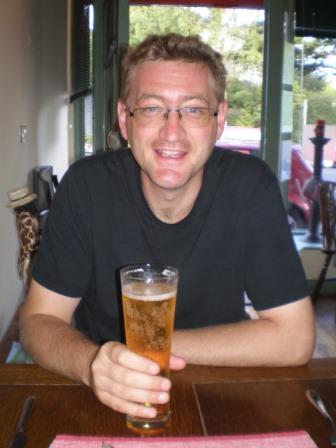
Today I’ll be hosting Christopher Griffith author of Rick With A (Bipolar) View in my blog. He is an accomplished author with 8 novels in his credit other than Rick With A (Bipolar) View. Christopher loves television, electronic music, Matthew, poetry, rip-roaring conspiracies, supermarkets, fantasy fiction from The Lord of the Rings to Harry Potter, and anything Shakespeare. He writes upon these subjects that in the study of them he will hopefully interest others, and learn thereby himself!
It is my pleasure to welcome Mr Griffith to this episode of the author interview.
- When did you first realize you wanted to be a writer?
I was 21 years old and having a torrid time on a teacher training course at the University of Reading; I absolutely loved the friends I was making these but the experience of teaching was just dire, and although I didn’t know it at the time I was also suffering from undiagnosed mental illness, bipolar disorder. Fighting this sickness was taking up much of my energy, and in fact, my whole body and soul was crying out for a change of direction in my life. I’d flirted with creative writing in my second year as an undergraduate, starting to write the book previous to this one but eventually getting bogged back down in the academic study of the time, and so one day, when I was sitting in my accommodation at Reading the memory of that venture, presented itself to me again and I thought, ‘Let’s finish writing that book.’
- How long have you been writing?
I’m 45 now, so 24 years. Wow, it doesn’t feel that long!
- What inspired you to write Rick With A (Bipolar) View?
As mentioned above, I was struggling with the condition bipolar disorder and in fact, had only just recently been diagnosed in April 1998; I finished writing my first book, Temples of a Fantasy Revenge that winter and was determined to start a different subject than fantasy for my next book. I also wanted it to be a stream-of-consciousness effort in which the narrator ‘talks’ to the audience of the book. Once I’d made that decision, and then further decided I’d put much of my then present self into the main protagonist, it became an easy final decision to populate the rest of the book with versions of my good friends at the time, friends with whom I’d shared great experiences back at school. I wanted to keep on record that kind of easy, lazy even lifestyle you have as a student when the only worries are really who you’re dating and when is the next party. I hope I’ve captured that sense in my book.
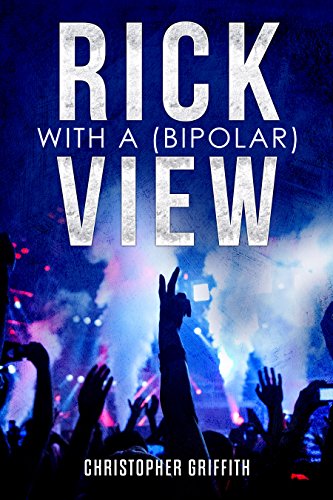
You can now purchase Kindle and Paperback versions of Rick With A (Bipolar) View from Amazon.co.uk
- What is the most difficult part of your artistic process?
Getting it right! I mean that and what I mean is that there are so many permutations needed to make a book work – you’ve got to get the characters right, the story, plot lines, dialogue, description, style, tone, rhythm, pace, spelling(!), and at the end of the day it’s really simple, the best books you read are the ones where all these things come together harmoniously, in equal measure. Have I achieved it? Well of course I hope so but you must be the judge of that! All I can say is that I bring my best effort to every composition I undertake and I really try to respect that bond between author and reader. There’s one last thing of course to the artistic process – inspiration. Mine doesn’t come from the clouds or a Muse but from everyday life in which an item on the news or an experience I have that day can inspire me to examine that situation, that story, in more detail. Once I’ve found inspiration, all those elements I’ve mentioned above then come to bear on the subsequent output; blending them together is the difficult part.
- What is the most surprising thing you discovered while writing your book?
The most surprising thing is that I was able to find any humour in the situation of having bipolar disorder. For all those who suffer from the condition, or know someone who does, the thought that you might be able to laugh at/with it is simply untenable. This is a horrid mental illness that invades the sufferer and tries to turn them against themselves. It can be stopped by medication of course, but also by the affection and love of those closest to us. When we’re in late adolescence and early adulthood that kind of support can come to us as much from friends as family, and so I went for an examination of the former realising along the way, particularly in the central chapter when Jimmy takes on Rick’s illness, that actually likes everything evil in the world, and bipolar disorder is that insidious, laughing at it can diminish and even expel its horror. Evil has no sense of humour, neither understanding it nor comprehending the power it has over darkness, decay and death. Sorry for getting a bit deep here, but along with suffering the tragedy of mental illness, try also to laugh at it too.
- Who is your favourite author and why?
My favourite author is Willard Price; I have favourite books of course but I have rarely read through an author’s entire output as I did with Willard’s books when I was in childhood. For those not in the know, these were a series of adventure stories in which two brothers found themselves tackling a variety of what could loosely be called ‘dangers’. The thing is, I learnt so much from these tales, that a person who is in a starving state can’t just be fed lots of food to fill them up and get their weight back, it has to be a much longer, drawn-out process. Much like when the brothers dive deep underwater and have to come up slowly or they get what can be called ‘the bends’. What I took on board the most here was the patience you have to have with life, surely a tremendous lesson given our society’s current infatuation with immediacy and having every craving satisfied straightaway. Favourite authors teach us life lessons, and I have never forgotten the importance of waiting patiently for the desired outcome.
- What books or authors have most influenced your own writing?
All of them. Every author I have read has had an impact on me and my writing, but if I had to be more determined it would be the great minds that have put pen to paper, Shakespeare, Chaucer, Milton right at the top. Then there were novels by authors like Henry Fielding, William Godwin, Mary Shelley whose style was a revelation for me, but then getting back down to earth there have also been a tremendous science fiction and fantasy authors, Arthur C. Clarke, Isaac Asimov, Philip K Dick, Tolkien, Robert Jordan, Terry Brooks whose work has developed and expanded my mind in entirely different ways to the Classics I’ve mentioned. I’ll also spare a word for all ‘normal’ reading material too, newspapers, magazines, anything in print or on-screen really which contains words. The English Language isn’t my forte, and I have no skills in that department, but I love words in any shape or form, always seeking to learn more about how to fit them together to make more effect.
- If you had to describe yourself in three words, what would they be?
Inquisitive, Ireful, Indefatigable
- Writing can be an emotionally draining and stressful pursuit. Any tips for aspiring writers?
Yes, I completely agree, and it can actually be dangerous to your health; I wrote a now-lost novel once which made me a thousand times more ill mentally than I had been before. The problem was, I lost control of the narrative. Sometimes that can be good when for example character takes on greater life than you thought and alters the plot accordingly, but you as the author still need to be in overall control of the story. If you feel it is running away from you, stop, read back and more often than not you’ll realise that at some point in the past you’ve let the plot slide into areas that don’t gel with where the story was going until that point. And that’s the most important tip I can give you because the writer’s hunch, just like the detective’s, must be acute at all times, and more importantly must be listened to and thereby acted upon. If you’re emotionally drained and stressed with your pursuit, recognise it early and put stop to it by recollecting your thoughts. Stop, go back, see where you turned left in your narrative rather than right, and then off you go again. Writing should never be laboursome, sometimes intense, yes, sometimes hard going, but not a chore, enjoyable.
- Are you working on anything at the present you would like to share with your readers about?
Yes, I’ve posted all the poetry I’ve written over twenty or so years on a blog which can be found at https://christophergriffith50.blogspot.com/ and whose last few poems I have only just been working on very recently. I’m also determined to write a thriller like the Da Vinci Code and have started planning that; lastly, I still keep my hand into the literature I first studied as an undergraduate and am working on a translation of a medieval poem called Piers Plowman by William Langland. This amazing writer worked on this single poem throughout his entire life and it really does offer the most amazing insight into the fourteenth century, a century often likened to our recent twentieth for how dreadful it was for the human race to sometimes live through and suffer. But we’re resilient, humankind, and we tend to get back to our feet when we’ve been cast on our behinds! Resilience, there’s my final word for being a writer. Don’t let anyone tell you how to or you can’t or what are you doing etc. if you want to write then sit down, take a piece of paper and cast your thoughts upon it…
Visit Christopher on https://www.williamottowaysutopia.com/ and do check out his books on Amazon.com
 The Ultimate Reviewer