For many centuries, millions of people who read the Bible consider it to be the word of God. Many readers of the Old Testament and the New Testament believe that God lives in heaven and human beings live on the planet Earth. Genesis 1:1 says, “In the beginning, God created the heaven and the earth.” Should we ask “where God had lived before he created heaven”? Had he been homeless, and that was why he had to create heaven?
In the Old Testament, we see humans were required some burnt offerings “of a sweet savor, a sacrifice made by fire,” and drink offerings. Should we ask, “was God homeless, hungry, and thirsty, and that was why he created heaven, humans, and animals, and required humans to offer burnt animals and drinks”?
Paul wrote in 2 Corinthians 3:13-14, “And not as Moses, which put a vail over his face, that the children of Israel could not stedfastly look to the end of that which is abolished: But their minds were blinded: for until this day remaineth the same vail untaken away in the reading of the old testament; which vail is done away in Christ.”? What is that “vail” in the reading of the Old Testament? Did Paul also tell us about the New Testament when he wrote in 2 Corinthians 3:6, “Who also hath made us able ministers of the new testament; not of the letter, but of the spirit: for the letter killeth, but the spirit giveth life”? Is there any difference between “the letter” and “the spirit”? Through these verses, should we read the Old Testament and the New Testament as we read a historical book?
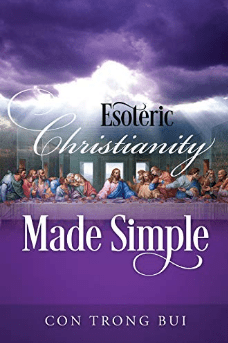
Title: Esoteric Christianity Made Simple
Author: Con Trong Bui
Pages: 354
My review
To reach the deepest understanding of faith not only gives a sense of salvation but also takes us to the height of faith. Esoteric Christianity Made Simple by Con Trong Bui is written in a way to create a greater understanding of the Holy Bible by eliminating literal doubts. Human beings are one of the greatest species ever walked on the earth. Only exceptional beings can dominate a planet. Although we are gifted with a creative and highly intelligent brain, when comes to the matter of the faith, we usually follow blindly. Often we neglect the logical questions raised in this subject. The answers always lie within but we never try to understand them. This book tries to bridge that gap.
I think theism and atheism are divided by a narrow gap of logical reasoning. Both ideologies have been fighting for their victory over others for ages. But what I learned by reading this book is everything can be explained logically. We have been reading the Holy Bible in a literal sense in all these years. The author has made clear in this book that the Old and New Testament are not simple historical books. We cannot read them just like other works of human beings. The scriptures were written to mean literally and symbolically at times. But they are not meant to be interpreted and understood literally. If we do, this arise questions. Jesus’s life and works are not symbols, but words about his life and works are. If we read between the lines and interpreted them correctly, everything will become simple.
The author has gone a great extend to eliminate many confusions. One such is the beliefs around “One God, who is Father, Son, and Holy Spirit”. This is the spine of Christianity. Yet many believers perceived this wrong. But if we study deeply this concept is very clearly explained in the Holy Bible beyond the scope of any doubt.
The author has done a commendable job by penning down this book. This will help a believer to gain wisdom and for a non-believer, to eliminate wide-spread doubts regarding the concepts of Christianity.
 The Ultimate Reviewer